

Face AI · On-Premises Deployment · Backend Engineering
1. Introduction
A face recognition demo can compare two images in seconds. An enterprise deployment has a different job: accept requests from multiple applications, resolve identities consistently, protect biometric data, and stay operational while devices, users, and models change.
An internal-server architecture is attractive when an organization wants centralized identity management, an on-premises deployment boundary, or shared inference resources. It is not automatically more secure or accurate than an on-device SDK. Those outcomes depend on the complete design.
This article follows our companion discussion of a production-ready face recognition SDK. Here, we focus on the engineering decisions behind an internal face recognition service, rather than describing a particular commercial AttFace API contract.
2. Define the Recognition Workflows First
Before selecting a model or database, distinguish three requests:
- Enrollment: validate an image, extract a template, and associate it with an authorized identity.
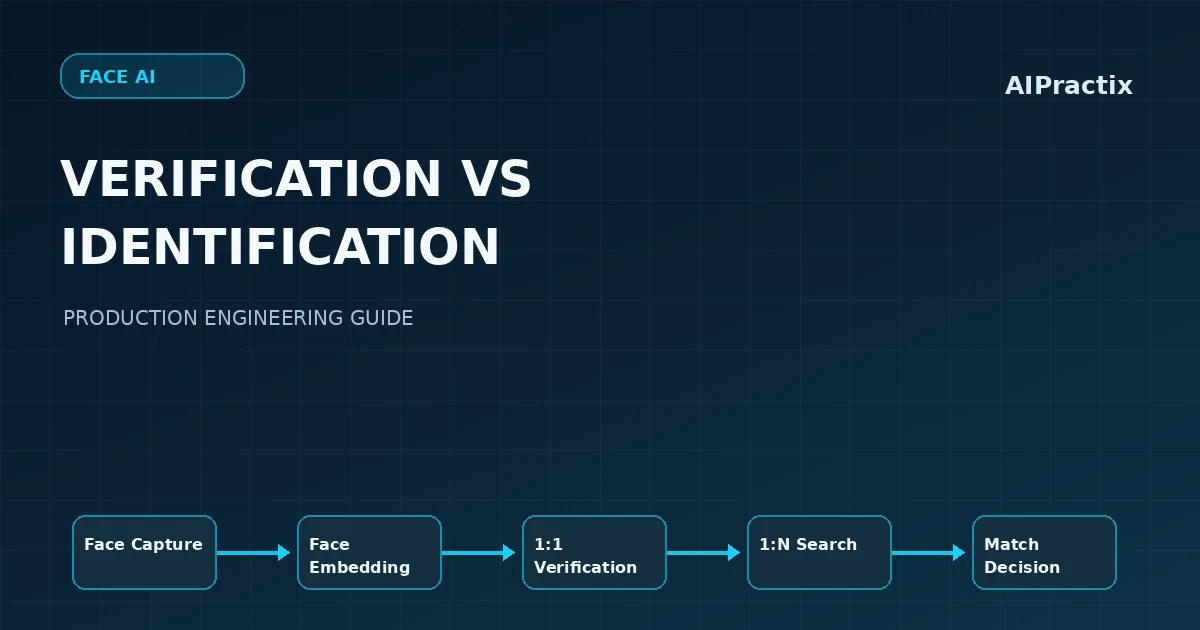
- Verification (1:1): compare an observation with the enrolled template of a claimed identity.
- Identification (1:N): search an eligible gallery and return ranked candidates, possibly with a rejection decision.
These requests have different security and performance properties. A verification result should not silently turn into identification when the claimed identity is unknown. Enrollment should have stricter quality and consent controls than a routine match request.
A useful API describes the operation explicitly instead of hiding all workflows behind an ambiguous /recognize endpoint.

3. Separate Services by Responsibility
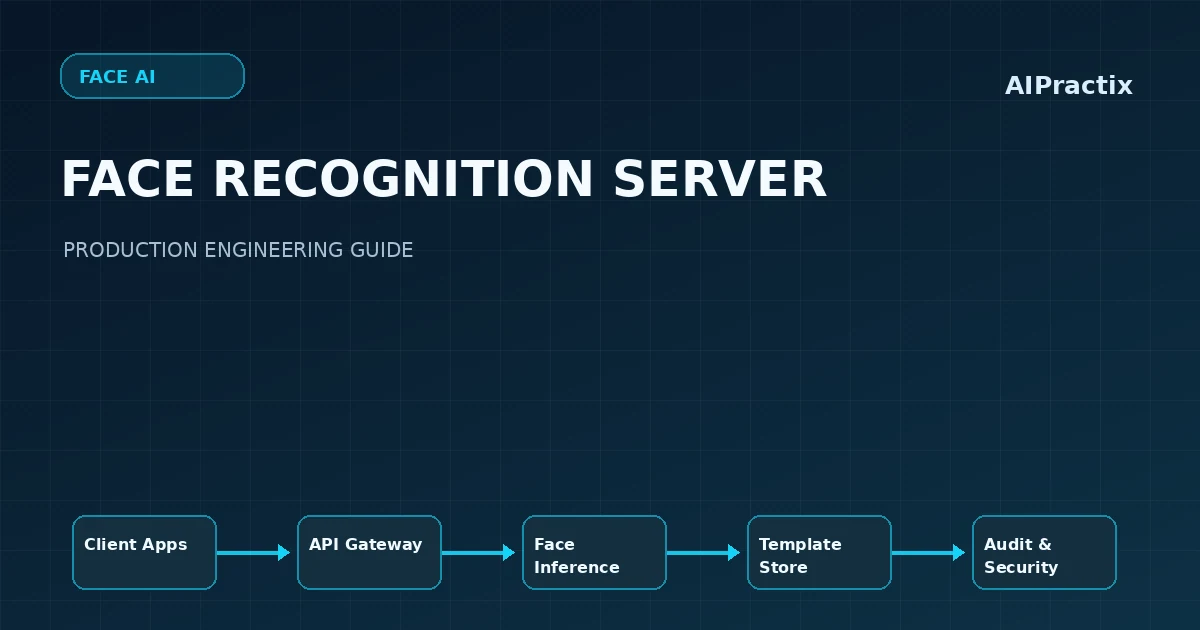
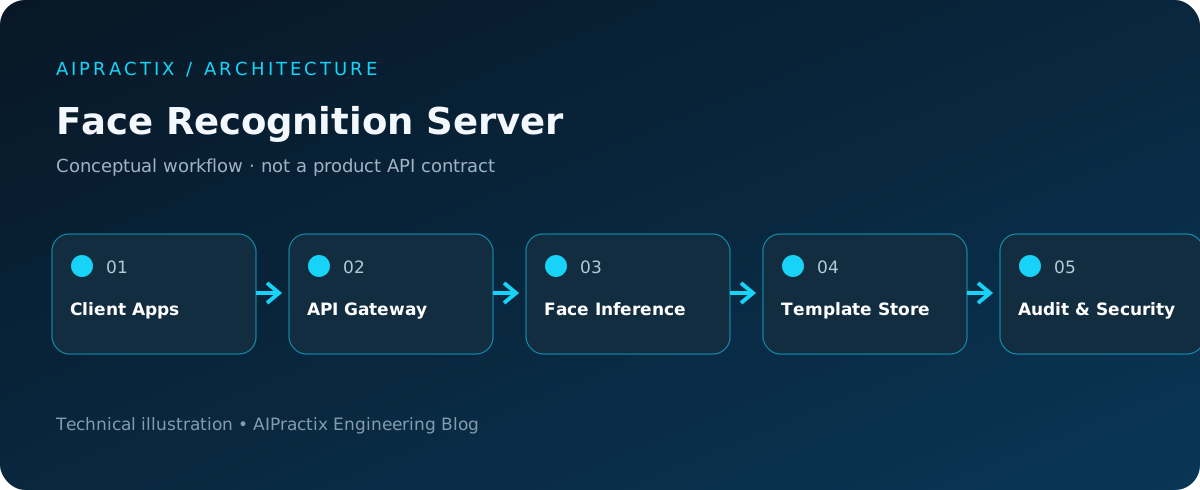
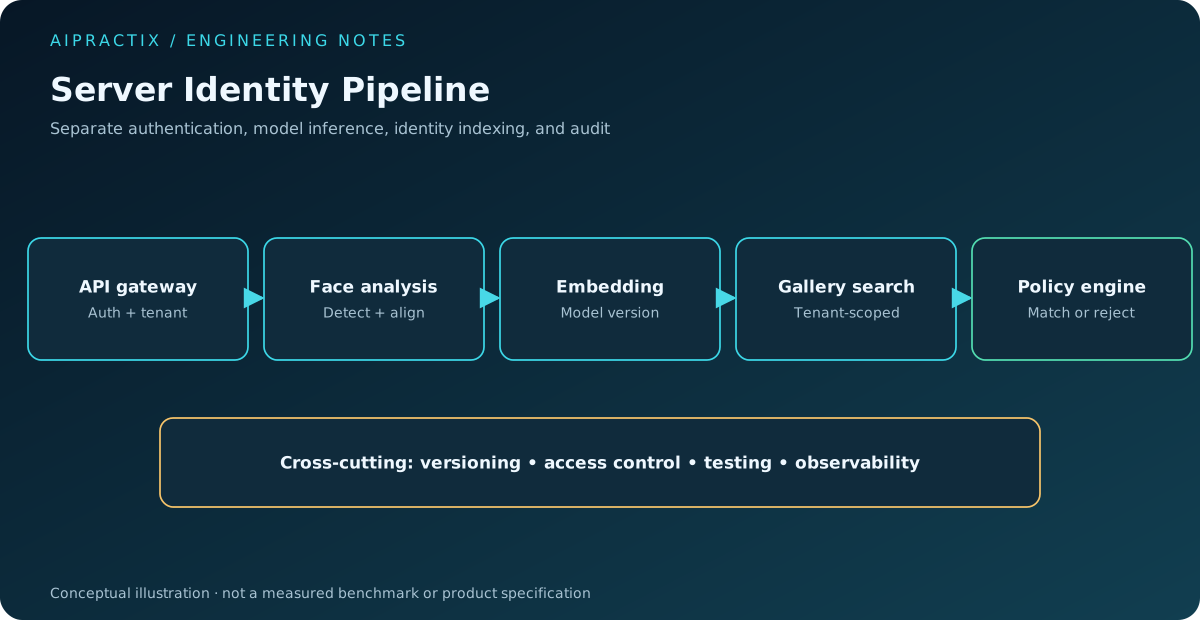
A conceptual server architecture has five parts:
The API gateway handles authentication, authorization, request limits, and transport security. The workflow service coordinates enrollment and matching policies. The inference service performs detection, alignment, embedding extraction, and optional quality or liveness analysis. The template store manages identity-to-embedding relationships, while audit systems track administrative and operational events.
Keeping these responsibilities separate allows inference capacity to scale without requiring the identity database or customer-facing API to scale in exactly the same way.
4. Design the Face Database for Lifecycle Changes
A face template is not merely a floating-point array. Its meaning depends on the embedding model version, preprocessing pipeline, enrollment conditions, and identity context.
A minimal conceptual record can include:
{
  "tenantId": "example-tenant",
  "subjectId": "employee-123",
  "embeddingVersion": "model-v1",
  "templateId": "template-abc",
  "status": "active",
  "createdAt": "2026-11-16T00:00:00Z"
}
Illustrative schema; not an AttFace database export.
Do not assume embeddings from different model versions are directly comparable. A model upgrade may require a compatibility strategy, parallel galleries, re-enrollment, or validated transformation. Deletion also needs to propagate to backups, replicas, and derived indexes according to a documented retention policy.
5. Build a Predictable Matching Layer
For 1:1 verification, the system typically retrieves the claimed identity's eligible template or templates and computes similarity. For 1:N identification, it searches the authorized gallery, returns candidates, and applies an application-specific decision rule.
The nearest candidate is not necessarily a valid match. Open-set recognition must support no match as a legitimate outcome. Thresholds should be calibrated for the real gallery size, capture conditions, user population, and tolerable false-match risk.
For large galleries, approximate nearest-neighbor indexes can improve retrieval speed, but the search stage must be evaluated separately from the underlying embedding model. Index recall, stale entries, and tenant filtering can all affect outcomes.
6. Operate Inference as a Service
Server performance is a pipeline problem rather than a single model-latency number:
Under load, queueing often matters as much as inference speed. Teams should benchmark request concurrency, p50/p95/p99 latency, error rates, memory use, and sustained throughput. Batch inference may improve utilization but can increase latency for individual requests.
Operational safeguards include health checks, bounded queues, timeouts, worker isolation, model warm-up, rolling deployments, and explicit failure behavior when a dependency is unavailable.
7. Secure the Entire Identity Boundary
An on-premises server reduces exposure to external cloud services only if deployment and operational controls are sound. Consider mutual service authentication where appropriate, role-based access, tenant isolation, secret management, encryption, audit logging, and network segmentation.
Face embeddings remain sensitive biometric information. Storing embeddings instead of source photographs does not eliminate privacy obligations. Define collection purpose, retention, subject deletion, access review, and incident response before a customer pilot.
In a multi-tenant installation, gallery filtering is a security boundary, not merely a query optimization. Test that one tenant cannot search, retrieve, modify, or delete another tenant's templates.
8. Test the System, Not Only the Model
A server release checklist should cover enrollment duplicates, wrong-identity claims, low-quality input, no-face and multiple-face inputs, mismatched model versions, expired authorization, deleted subjects, network interruptions, peak traffic, and tenant isolation.
Measure the end-to-end false match and false non-match behavior on representative data. A good embedding benchmark cannot compensate for broken cropping, permissive policies, stale search indexes, or inconsistent enrollment.
9. SDK, Server, or Hybrid?
Choose an SDK when low latency, device autonomy, and offline inference dominate. Choose an internal server when centralized galleries, shared controls, and managed inference are more important. A hybrid architecture can extract embeddings locally and coordinate authorized server-side matching, although its privacy and network trade-offs still need assessment.
At AIPractix, our AttFace work spans the practical engineering considerations of reusable Face AI components and real-world application integration. The right deployment model follows the customer workflow—not the other way around.
10. Conclusion
Production-ready Face AI requires reliable APIs, model-version discipline, data governance, performance engineering, and operational testing. The recognition model is an essential part of the system, but the surrounding architecture determines whether enterprises can trust it over time.