

Face AI · Biometrics · System Design
1. Two Similar Interfaces, Different Problems
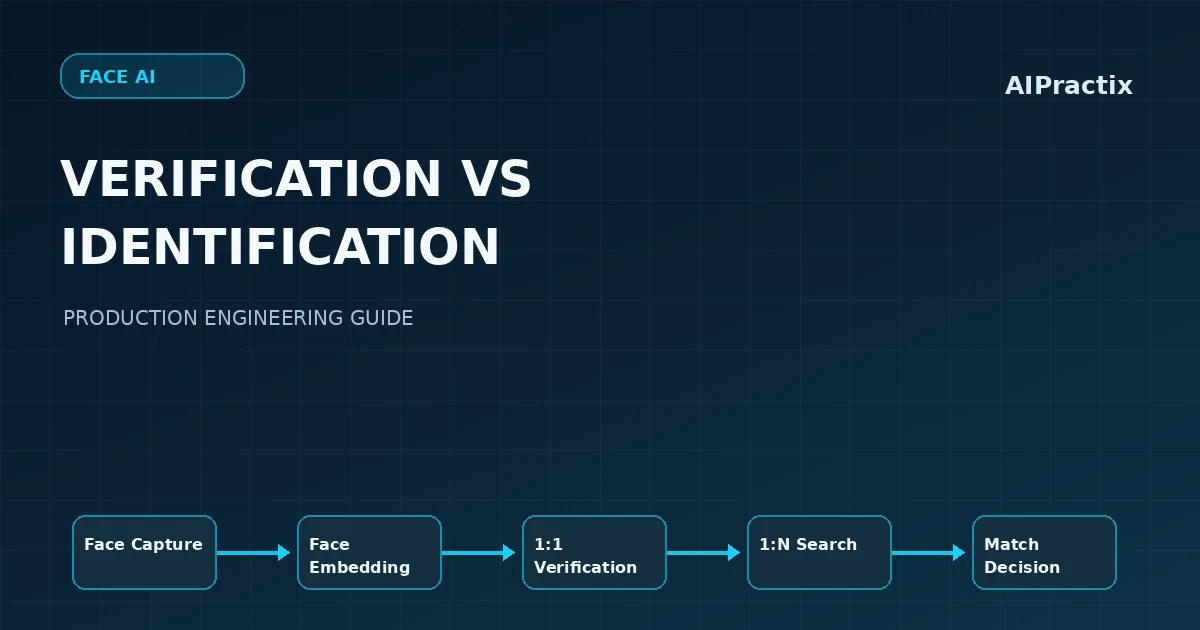
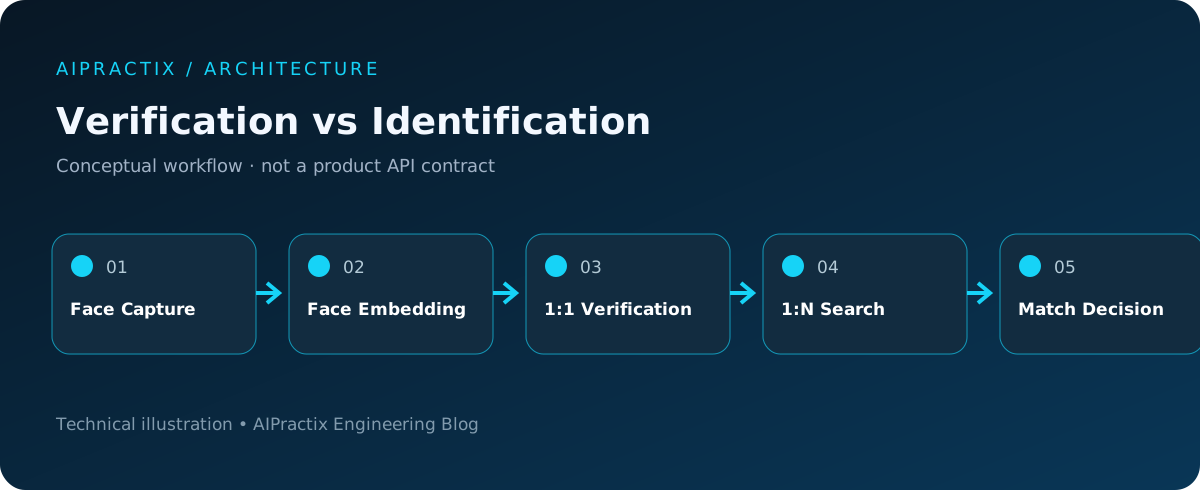
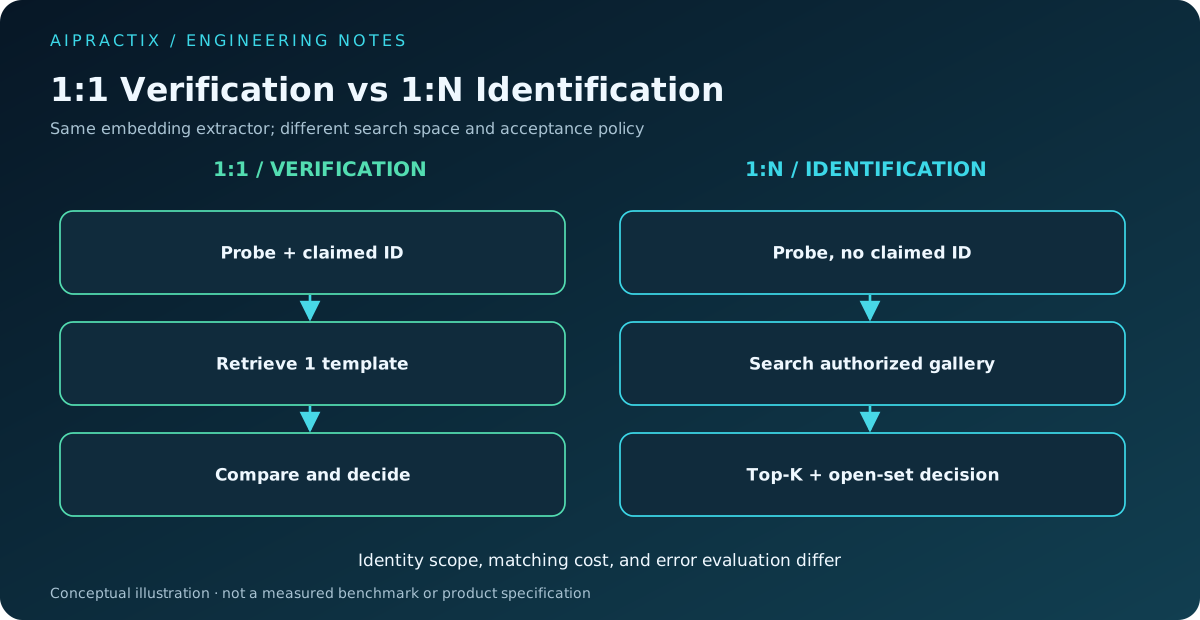
Face verification asks: Does this face match the claimed identity? Face identification asks: Who, if anyone, in an authorized gallery matches this face? The two tasks can use the same detector and embedding model, but their decision logic and risk profiles differ.
Choosing the wrong workflow can create unnecessary computation, privacy exposure, and false matches. For example, an employee who submits an identifier for verification does not necessarily need to be searched across every employee in an organization.
2. The Shared Face Analysis Pipeline
Both tasks usually begin with detection, quality assessment, alignment, and an embedding extractor. The embedding is a vector representation designed so that samples of the same person are generally more similar than those of different people under the model's training objective.
Cosine similarity is one common measure:
The resulting value is a comparison score, not a calibrated probability of identity. Interpretation depends on the model and evaluation context.
3. Verification: 1:1
In a verification request, the user or application presents a claimed identity. The system retrieves the eligible enrollment template and compares it to the new observation.
A simplified decision is:
The threshold is selected against a desired false match rate (FMR) and false non-match rate (FNMR). Applications involving sensitive access may prioritize minimizing false matches, while some lower-risk workflows may accept more retries to improve usability.
A robust 1:1 API should distinguish an unknown claimed ID, unavailable reference, poor capture, liveness failure, and legitimate non-match.
4. Identification: 1:N
For identification, the probe is compared with a gallery of N enrolled candidates. The system may return a ranked candidate list, but the top candidate alone is not evidence that a valid enrolled identity exists.
This is the open-set case: the correct answer can be no enrolled match. In contrast, closed-set evaluation assumes the person belongs to the gallery. Real attendance, visitor, and access-control applications frequently need open-set behavior.
As the gallery grows, the probability of finding an unusually high accidental similarity can change. Consequently, a threshold calibrated for a small gallery should not be copied into a very large deployment without re-evaluation.
5. Search Architecture for Larger Galleries
Small galleries may use direct similarity computation. Larger galleries may benefit from a vector index or approximate nearest-neighbor search. An index speeds candidate retrieval but adds questions about search recall, index rebuilds, deletion propagation, and consistency.
A sound architecture treats candidate retrieval and final decision-making as separate stages:
Filtering by tenant, site, or authorized population should happen before or within retrieval and be enforced as an access boundary.
6. Multiple Templates per Person
An identity may have several enrollment images to represent normal appearance variation. This can improve robustness, but it complicates scoring and lifecycle management.
Teams must define whether to use a maximum score, an aggregation function, or a representative template. Every strategy should be validated, especially if template counts differ between identities. Unchecked accumulation of old templates can also preserve poor-quality or outdated data.

7. False Matches Have Context
Model accuracy cannot be reduced to one number. Evaluation should consider FMR, FNMR, identification false positive and false negative behavior, gallery size, threshold, demographics where appropriate and lawfully evaluated, capture conditions, and error costs.
For identification, also analyze outcomes for probes not represented in the gallery. For verification, test both genuine and impostor identity claims. PAD should be evaluated separately from recognition and again at the integrated workflow level.
8. Use Cases and Trade-offs
1:1 verification is often appropriate for confirming a declared account, employee ID, or registration. 1:N identification can suit shared kiosk check-ins or authorized identity search, provided the gallery is restricted and consent and governance are in place.
Hybrid workflows are possible. A system might identify a small candidate set, then require a second factor or human confirmation for a sensitive action. The appropriate architecture follows both the product UX and its threat model.
9. Versioning and Data Governance
Record the embedding version, enrollment provenance, and allowed purposes. A model upgrade may shift score distributions even when the embeddings have the same dimensionality. Do not mix incompatible galleries without validation.
Provide deletion, re-enrollment, audit, access control, and retention policies. Biometric templates should never be treated as anonymous just because they contain numerical values.
10. Conclusion
The distinction between 1:1 and 1:N is not an API naming detail. It affects scalability, calibration, privacy, user experience, and failure handling. A well-designed Face AI platform exposes both workflows clearly and lets applications choose only the identity operation they actually need.