

Computer Vision · Model Evaluation · MLOps
1. The Benchmark Gap
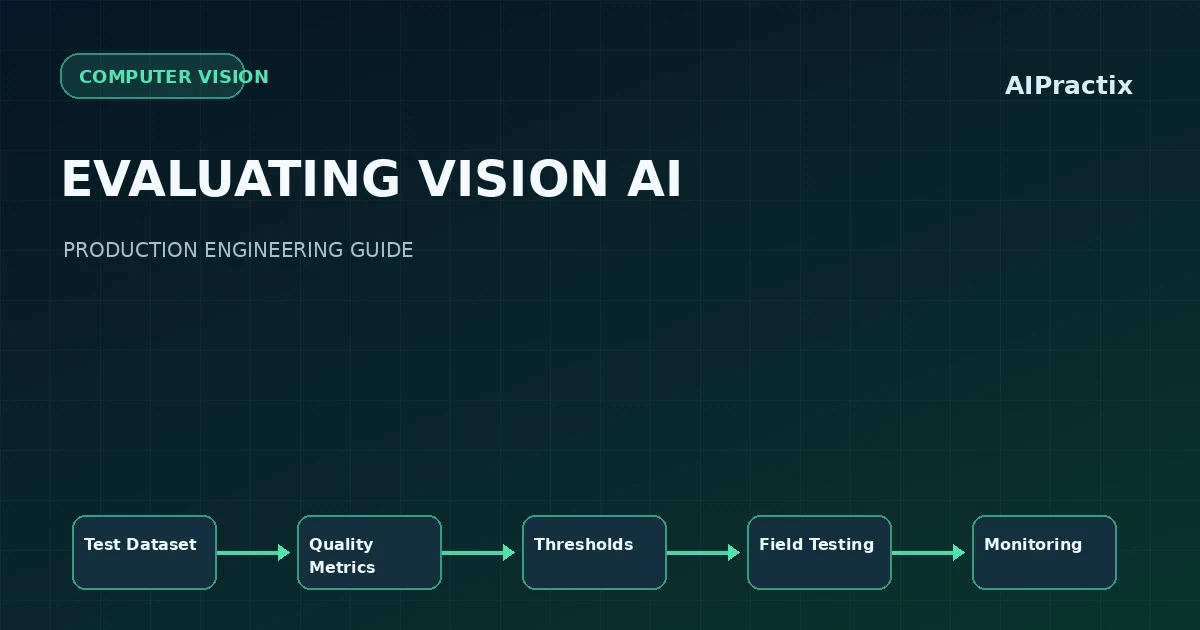
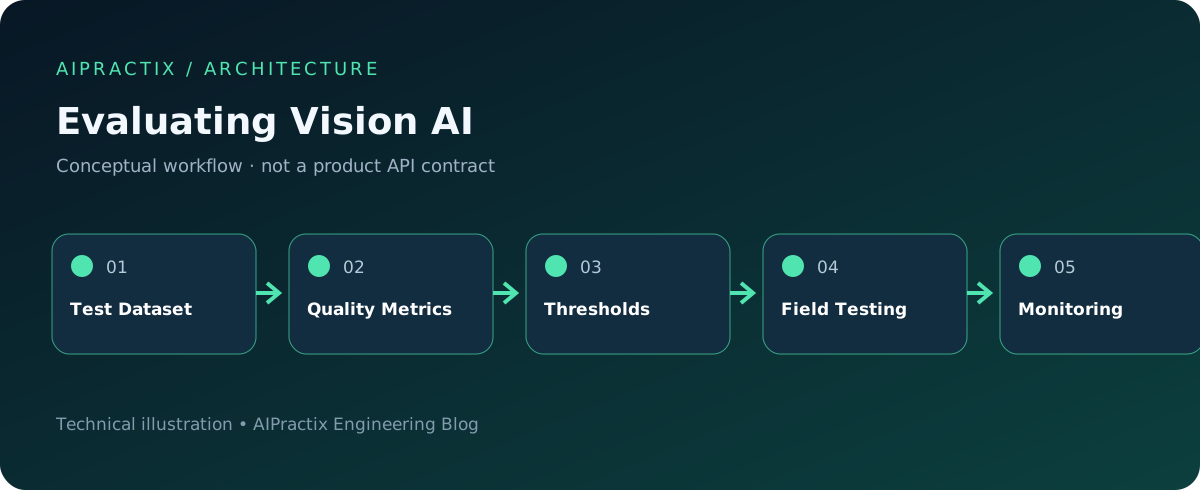
A computer vision model may achieve a strong result on an established benchmark and still disappoint customers. The model might struggle with the deployment camera, night lighting, image compression, unusual viewpoints, or real-time requirements.
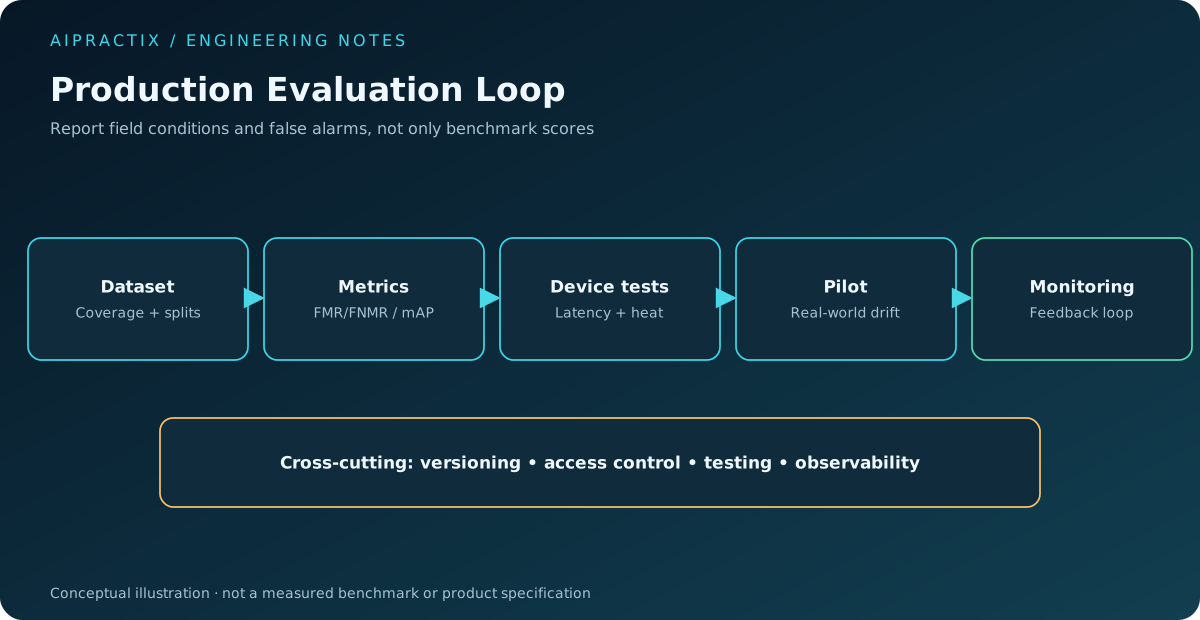
Production readiness requires two complementary questions: How well does the model perform on relevant examples? and How reliably does the complete application perform the intended workflow? Neither can replace the other.
2. Define the Operational Decision
Before selecting metrics, define what the system's output changes. A false detection in a dashboard may be inconvenient; a false acceptance in identity verification can have much higher consequences.
Specify the unit of evaluation: frame, object, person, track, event, or user session. Frame-level accuracy is often insufficient for a video alarm that should trigger only after a persistent condition.
3. Use Task-Appropriate Metrics
| Task | Useful metrics | Common blind spot |
|---|---|---|
| Object detection | Precision, recall, mAP | False alerts per operating hour |
| Classification | Confusion matrix, precision/recall | Class imbalance |
| Face verification | FMR, FNMR at defined thresholds | Capture and enrollment failures |
| Open-set identification | False positive identification, miss rates | Unknown individuals |
| Tracking | ID switches, association and detection metrics | Long-term track fragmentation |
| Event detection | Event precision/recall, detection delay | Alert fatigue |
Metrics must be accompanied by evaluation conditions. A result without a defined dataset, operating point, and protocol is difficult to interpret.
4. Construct Representative Test Sets
Collect authorized evaluation samples that reflect camera types, locations, lighting, motion, user behavior, and failure conditions. Separate data by relevant subjects, cameras, sites, or time periods when leakage would make results overoptimistic.
Maintain hard-negative cases: visually similar identities, occlusion, reflective screens, backlighting, and borderline events. Avoid repeatedly tuning on the final holdout set.
Document annotation rules. Inconsistent labels can create apparent model errors—or conceal real ones.
5. Calibrate Thresholds Against Business Risk
Many applications turn a continuous score into a binary action. That threshold should be selected using development and calibration data, with an explicit trade-off between false positives and false negatives.
For example, raising a face verification threshold may reduce false matches while increasing legitimate-user retries. For industrial event alerts, a stricter threshold may reduce nuisance notifications but miss important incidents.
Report performance at the chosen operating point, not only at the model's best possible benchmark point.
6. Evaluate the Full Pipeline
Image rotation, cropping, alignment, color channel conversion, frame sampling, tracking, and business rules can all alter results. Test the exact runtime and preprocessing used in production.
A detector may be fast alone yet slow within an application that repeatedly copies large image buffers. Conversely, sampling fewer frames can reduce compute while changing event recall. Such trade-offs require end-to-end measurement.
7. Measure Operational Performance
Record p50/p95 latency, throughput, peak memory, initialization time, sustained operation, energy or thermal behavior where relevant, crash rate, network failure recovery, and monitoring coverage.
For server inference, include queueing and network costs. For mobile inference, test representative low-end and older devices rather than only flagship hardware.
8. Monitor Data and Model Drift
Production input changes when camera angles shift, new uniforms appear, seasons change, or customers expand sites. Monitoring should capture permitted, privacy-conscious indicators of input quality, score distributions, error reports, and alert volumes.
Distinguish performance degradation from infrastructure incidents. A fall in detection count could reflect fewer people in the scene, a disconnected camera, or a real model regression.
9. Run Controlled Releases
Version the entire pipeline: model weights, preprocessing, thresholds, runtime, and post-processing. Use regression suites and staged rollouts where possible. Compare new and previous releases on the same evaluation protocol before changing the production decision policy.
When a change affects face embeddings, validate gallery compatibility explicitly. When it affects event rules, compare downstream false-alarm volume and customer workflow impact.
10. Conclusion
Successful computer vision deployment is an evidence-based engineering process. Models, datasets, thresholds, runtimes, and operations must be evaluated together. That discipline makes AI features easier to integrate, maintain, and defend in real customer environments.