

Computer Vision · Person Re-Identification · Multi-Camera Analytics
1. The Multi-Camera Challenge
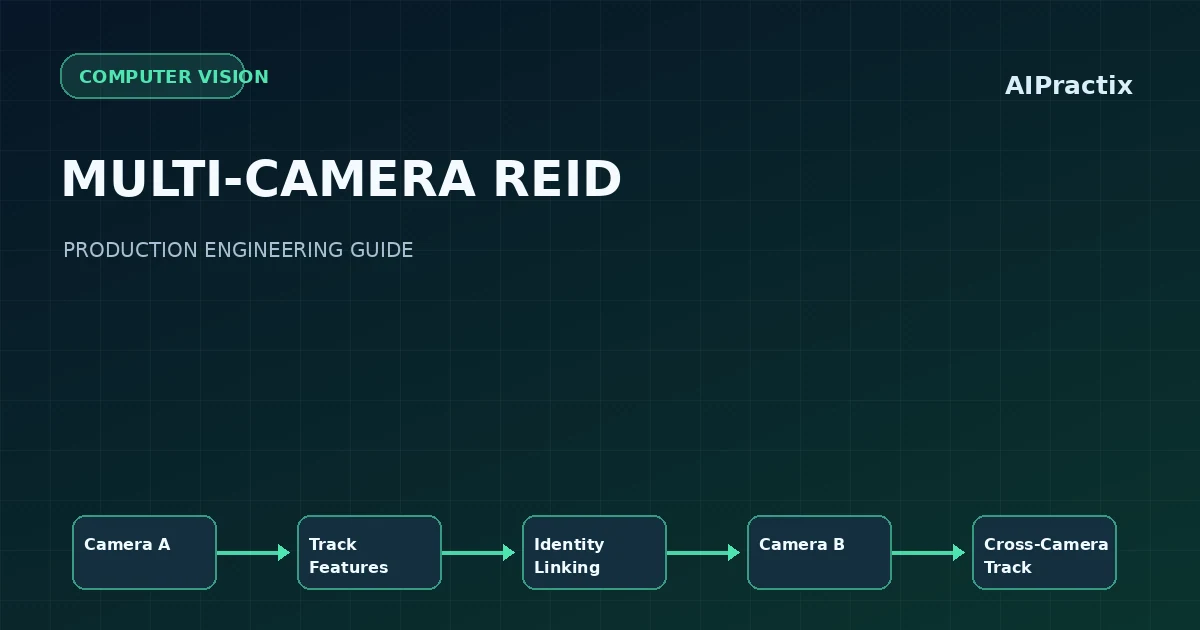
A tracking algorithm can often follow a person within one continuous camera stream. Following that person after they leave the frame and appear on another camera is a different problem.
Person re-identification (ReID) estimates whether observations from separate viewpoints likely depict the same person. It commonly uses clothing, appearance, and learned visual features rather than necessarily identifying a person's legal identity.
ReID is useful for authorized multi-camera flow analysis, but a visual match is not proof of identity. Clothing changes, uniforms, crowding, and similar appearances can make matching unreliable.
2. Tracking Is Not Re-Identification
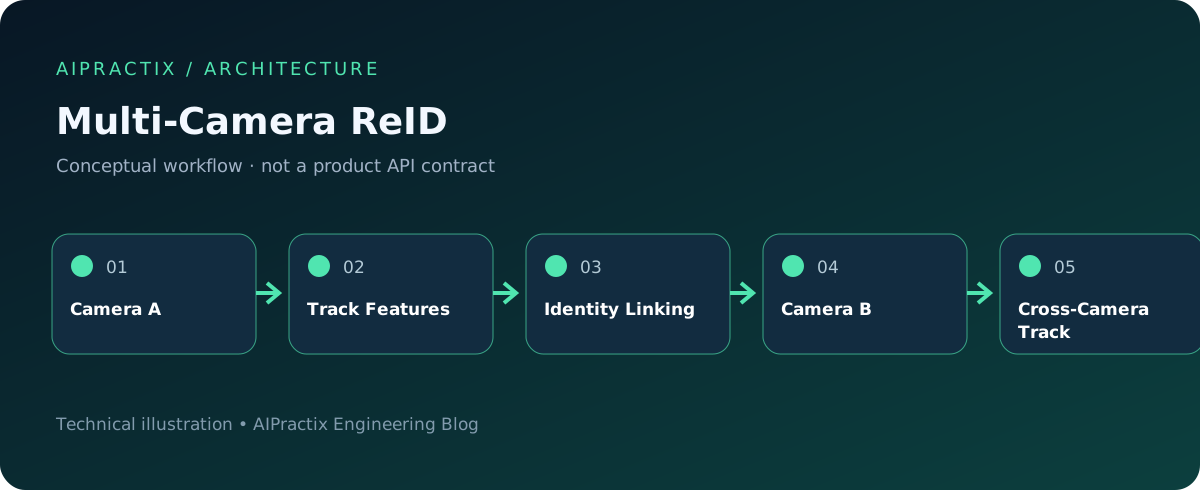
Single-camera tracking associates nearby detections over adjacent frames using motion, overlap, and appearance cues. ReID compares observations across discontinuities in time or viewpoint.
A multi-camera system may combine both:
The goal is to avoid treating each detection as an isolated photograph while also avoiding unjustified global identity assignments.
3. Learn Appearance Representations
ReID models produce embeddings that summarize visual appearance. Similarity search retrieves likely candidates from authorized track records. Compared with face recognition, person ReID can be more affected by clothing, background, pose, occlusion, and camera color differences.
A good crop policy matters. Detection boxes containing substantial background or multiple overlapping people can corrupt embeddings. Teams should evaluate how aggregation across several frames compares with using a single best frame.
4. Add Spatiotemporal Constraints
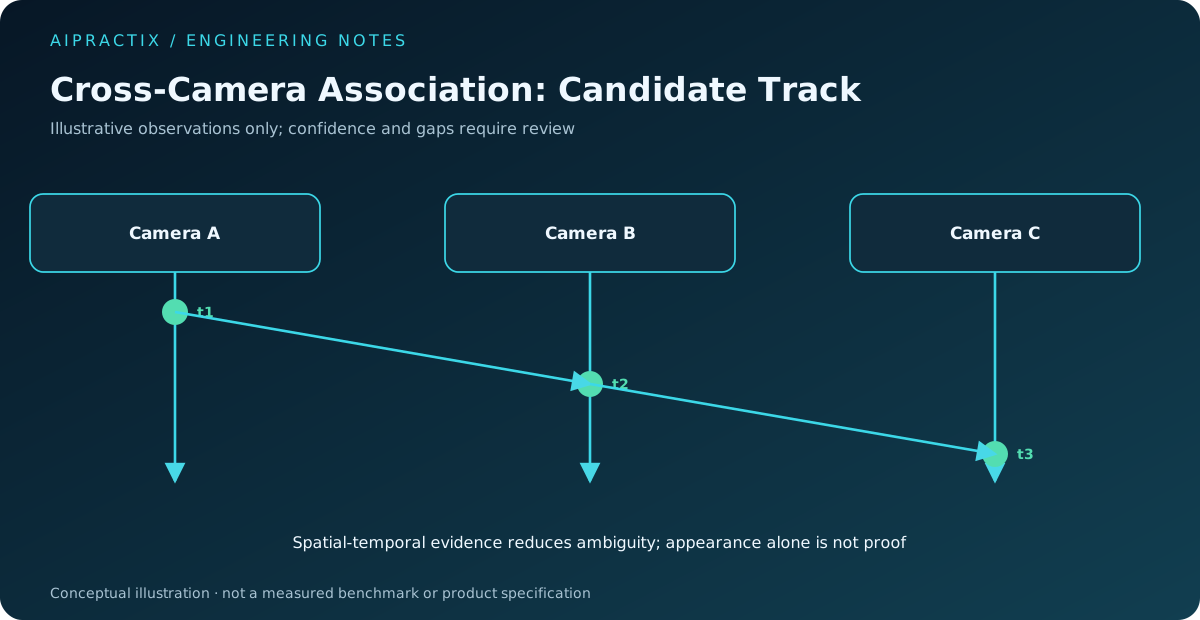
Camera topology provides important context. If two cameras are several minutes apart by walking distance, a candidate appearing on both within one second may be implausible. Likewise, disconnected zones should not be automatically joined merely because embeddings are similar.
A matching system can combine appearance similarity with travel-time distributions and transition probabilities. The weights require calibration on the deployment layout and should allow unknown or unmatched outcomes.
5. Handle Appearance Drift
Lighting changes between indoor and outdoor cameras. People may put on jackets, carry bags, turn away from the lens, or enter crowds. Long gaps magnify these problems.
Maintaining multiple representative track observations can improve robustness, but stale templates can also create false associations. Define track lifetime, gallery expiration, aggregation strategy, and procedures for resolving ambiguous candidates.
6. Understand the Evaluation Protocol
Common ReID research metrics include rank-1 accuracy and mean average precision (mAP). These measurements depend strongly on the benchmark's identity splits, camera setup, and gallery construction.
For deployed multi-camera systems, also measure false association rates, missed links, ID switches, and end-to-end track continuity. A model can perform well on an academic benchmark while failing under different camera heights or crowded local scenes.
7. Real-Time Engineering
Computing a ReID embedding for every detection on every frame may be unnecessarily expensive. A tracking system can select representative frames and update appearance features periodically.
Define maximum candidate gallery size, ANN retrieval behavior, expiration rules, and backpressure. Synchronize timestamps when making cross-camera temporal decisions; unsynchronized camera clocks can invalidate otherwise useful movement constraints.
8. Privacy and Permitted Use
ReID can enable persistent tracking, so deploy it only for a clearly authorized purpose with appropriate safeguards. Restrict retention, visibility, cross-site correlation, and export. Prefer aggregated occupancy or flow analytics when individual-level linkage is unnecessary.
Face recognition and person ReID should not be silently combined to identify people beyond the stated purpose. Transparency and governance are part of the architecture.
9. Design for Ambiguity
A practical system needs confidence tiers and an option to leave trajectories unlinked. Human review may be necessary in sensitive contexts. Present cross-camera associations as inferred links with supporting evidence and limitations, not unquestionable identity facts.
10. Conclusion
Person ReID expands video analytics beyond a single camera, but it is not simply face recognition without a face. Production systems need appearance embeddings, track aggregation, camera topology, temporal logic, calibrated uncertainty, and responsible data handling.