

Good AI projects begin with a workflow, useful evidence, and a decision worth improving—not with a model name.
1. Start With the Problem, Not the AI Model
When a company considers an AI project, the first questions often sound technical:
- Should we use a large language model or a computer vision model?
- Do we need to train our own model?
- Should inference run in the cloud or on our servers?
- How much data is needed to get started?
These questions matter, but they rarely belong at the beginning of the conversation.
At AIPractix, we approach AI engineering as a way to improve real operations. Before choosing a model or architecture, we want to understand what people are doing today, where the friction occurs, and what a better outcome would look like.
A company does not need an AI specification to start talking to an AI team. A clear description of its business problem is usually a much more valuable starting point.
Sometimes the right answer involves AI. Sometimes a rule-based system, better software integration, or a simpler workflow change will deliver more value. A capable technology partner should be willing to explore all three.

2. Describe the Current Workflow
Instead of beginning with “We want an AI system,” describe what happens from start to finish.
Consider a company that wants to reduce manual review of images:
- A customer or employee submits an image.
- A staff member inspects it against a set of requirements.
- The staff member accepts it, rejects it, or asks for another image.
- The result is entered into an internal system.
- Exceptions are escalated for review.
This workflow raises more useful questions than the phrase “We need image recognition.”
Which step consumes the most time? Which mistakes are costly? Are the rules consistent? Is the goal to automate the whole process, or to help reviewers prioritize difficult cases?
A useful preparation exercise is to write down:
- Trigger: What starts the process?
- Input: What information does a person receive?
- Decision: What judgment or action must be made?
- Output: What happens after that decision?
- Exceptions: What happens when the case is unclear?
A simple flowchart, a few screenshots, or a short screen recording is often enough for an initial technical discussion.
3. Define the Outcome You Want to Improve
“Make it smarter” is not a measurable business objective.
A more useful goal might be to reduce review time, decrease avoidable errors, improve response speed, make information easier to find, or support a service without adding proportional staff effort.
Different outcomes lead to different engineering choices.
| Business objective | Questions to clarify |
|---|---|
| Reduce manual work | Which tasks are repetitive, and how many cases occur per day? |
| Improve decision quality | Which mistakes matter most, and what happens when they occur? |
| Improve customer experience | Where do customers wait, repeat information, or abandon a process? |
| Search a large collection | What should users be able to find, and how will relevance be judged? |
| Detect operational events | Which events require action, and how quickly must they be reported? |
The value of an AI system is not simply its model accuracy. It is the improvement it creates within the business process.
For example, a highly accurate classifier may offer little practical value if its output cannot be integrated into the software employees already use.
4. Bring Representative Data, Not Necessarily a Perfect Dataset
Many businesses hesitate to contact an AI team because they do not have a clean, labeled dataset.
That should not automatically stop the conversation.
An experienced AI engineering partner can help assess what data is available, whether it is usable, what additional examples are needed, and whether a pretrained model could provide a reasonable starting point.
Useful materials may include:
- Sample images, videos, documents, or records from the actual workflow.
- Examples of both successful and failed cases.
- Existing business rules, forms, or review guidelines.
- Information about how the data was collected.
- Approximate volumes and expected future growth.
- Known restrictions on data access, retention, or transfer.
Representative data matters more than an impressive number of files.
A few carefully selected examples showing normal operations, edge cases, and common failures can reveal important feasibility risks early. They do not replace a proper evaluation dataset, but they help identify what needs to be tested.
What if the company has very little data?
There are still several possible starting points:
- Evaluate existing models on a small, authorized sample.
- Build a limited proof of concept to test technical feasibility.
- Design a data collection and annotation process.
- Start with human-in-the-loop assistance instead of full automation.
- Narrow the initial use case to a more reliable subset.
The important question is not “Do we already have everything?” but “Can we establish a responsible path to evidence?”
Data should only be shared when the company has the appropriate rights and safeguards. Sensitive customer information, employee records, and biometric data may require anonymization, restricted access, explicit authorization, or a controlled evaluation environment.
5. Clarify the Cost of Mistakes
AI systems make predictions under uncertainty. This is especially important for computer vision, identification, classification, retrieval, and language-based applications.
Before discussing model accuracy, ask what happens when the system is wrong.
A false positive and a false negative may have very different business costs.
For example, an AI system that flags potentially unusual events can often tolerate some false alerts if a human reviews them. A system that automatically denies access or makes a consequential decision may require a much more conservative design and additional safeguards.
A useful discussion covers:
- Which mistakes are unacceptable?
- Which results can be reviewed by a human?
- Can the system say “uncertain” or “needs review”?
- Is a decision reversible?
- Who is accountable for the final action?
Do not begin by asking for “99% accuracy” without defining the dataset, evaluation method, and type of error being measured. That number alone does not describe whether a system is safe or useful.
6. Explain Where AI Must Fit Into Existing Software
A promising model is not yet a usable product.
The AI component may need to exchange data with an ERP, HRM, LMS, CRM, mobile app, camera system, or internal database. This integration often determines the real project complexity.
Before hiring an AI team, it helps to know:
- Which applications are involved?
- Are APIs or database interfaces available?
- Which team owns the existing software?
- Does the system require real-time responses or batch processing?
- Must it continue working without internet access?
- Where will results be displayed and acted upon?
These details help distinguish an isolated demonstration from an implementable solution.
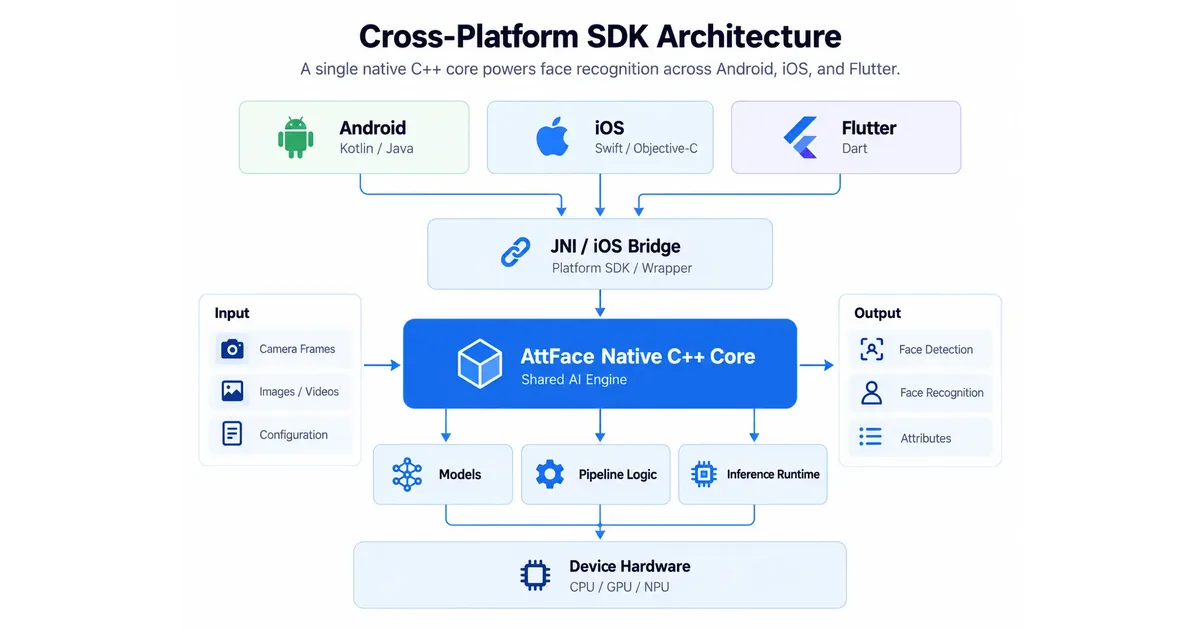
For example, a face recognition component may be delivered as an on-device SDK, an internal inference server, or a hybrid architecture. The appropriate choice depends on the workflow, infrastructure, privacy requirements, and integration constraints—not on which approach sounds more advanced.
7. Share Your Deployment, Privacy, and Ownership Constraints Early
Some important requirements are not visible from sample data or a feature list.
An organization may require on-premises deployment, limited network access, specific operating systems, integration with existing infrastructure, or strict control of biometric and personal data.
Discuss these constraints at the beginning:
Infrastructure: Cloud, private cloud, on-premises server, mobile device, or edge hardware.
Data governance: Where data is stored, who can access it, how long it is retained, and how deletion works.
Security: Authentication, authorization, auditing, encryption, and incident-handling expectations.
Technology ownership: Who owns project-specific code, training data, configurations, and deliverables?
Licensing: Will the solution use reusable third-party or partner-owned AI components, and what usage rights will the business receive?
This last distinction deserves attention. A company may not need exclusive ownership of every underlying AI algorithm to own and control its product. A reusable AI core can be licensed while the business retains control of its application, customer relationships, and project-specific systems.
The right arrangement should be made explicit in the contract, including maintenance, upgrades, exit options, and any dependencies that could affect the business over time.
8. Start With a Small, Measurable Pilot
A full production rollout should not be the first time a company discovers whether an AI approach works on its data.
For projects with material uncertainty, a staged process is often more effective:
Stage 1 — Discovery and feasibility
Define the workflow, constraints, available data, important failure cases, and measurable success criteria.
The outcome may be a recommendation to proceed, narrow the use case, collect more evidence, or avoid AI entirely.
Stage 2 — Proof of concept
Test whether a candidate technical approach can handle representative cases.
A proof of concept helps answer technical questions; it does not establish production readiness.
Stage 3 — Pilot in the real workflow
Connect the solution to a limited operating environment. Observe real user behavior, integration issues, latency, edge cases, and human review requirements.
Stage 4 — Production engineering
Strengthen security, deployment, monitoring, reliability, documentation, support, and maintenance based on what the pilot reveals.
These stages are not rigid contractual packages. Some straightforward integrations need less discovery, while complex or high-risk applications require more extensive validation.
The purpose of a pilot is to reduce uncertainty before a larger commitment—not simply to produce an impressive demo.
9. Prepare a Realistic Budget and Timeline Discussion
You do not need to know the exact AI implementation cost before contacting a development partner.
You should, however, be able to describe the business scale and any hard constraints.
For example:
- Is this an internal prototype or a customer-facing product?
- How many users, devices, cameras, or requests are expected?
- Is there an existing engineering team to handle application integration?
- Is the project tied to a launch date or external commitment?
- Is the company comfortable with an initial paid discovery or pilot phase?
- What ongoing infrastructure and support costs would be acceptable?
AI project costs can include far more than model development: data preparation, annotation, integration, compute infrastructure, evaluation, monitoring, security, updates, and support all matter.
A credible engineering partner should explain these cost drivers and distinguish one-time development work from recurring operating costs.
10. How to Evaluate an AI Engineering Partner
A strong proposal should demonstrate understanding of both the business process and the technology.
Look for a team that can explain trade-offs clearly and is willing to challenge unsuitable requirements.
Useful questions include:
| Question to ask | What a useful answer should clarify |
|---|---|
| Have you worked with similar technical constraints? | Relevant engineering experience and its limits |
| Would you train a model or reuse existing technology? | The reasoning behind that choice |
| How will you evaluate success? | Data, metrics, failure cases, and acceptance criteria |
| How will the system integrate? | APIs, SDKs, responsibilities, and dependencies |
| What happens when the AI is uncertain? | Human review, fallback, and error handling |
| How will we maintain the system? | Monitoring, upgrades, support, and compatibility |
| Who owns what? | Clear IP, licensing, data, and exit terms |
Be cautious of guarantees that are not tied to an evaluation method or representative operating conditions.
Similarly, a polished model demonstration should not be confused with evidence that a complete production system is ready.
For long-term partnerships, communication quality, transparency, maintainability, and mutual understanding are just as important as the initial technical demonstration.
11. A One-Page AI Project Brief Is Often Enough to Begin
Before the first meeting, try preparing a short document using this structure:
| Item | What to write |
|---|---|
| Business problem | What is difficult, slow, costly, or inconsistent today? |
| Current workflow | Who does what, using which inputs and systems? |
| Desired improvement | What should become faster, easier, or more reliable? |
| Available data | What representative examples can be evaluated safely? |
| Failure tolerance | What kinds of mistakes matter most? |
| Integration | Which applications, APIs, devices, or databases are involved? |
| Constraints | Privacy, deployment, security, ownership, or regulatory needs |
| Pilot scope | What small real-world test would be meaningful? |
| Stakeholders | Who makes decisions and who will operate the result? |
Not every field needs a complete answer.
Unknowns are useful information too. They tell the AI team where discovery work is needed.
12. How AIPractix Approaches Collaboration
At AIPractix, we focus on practical AI engineering: taking useful technology from research and prototypes into real-world software systems.
Our technical interests include computer vision, face recognition, visual and semantic search, and intelligent event analysis. Through technologies such as AttFace, we also explore reusable AI components that software companies can integrate into their own products.
We believe a good engagement should begin with clear questions rather than a predetermined model or expensive architecture.
For some partners, the most sensible approach is to integrate a reusable AI SDK or licensed core. For others, a custom inference service or end-to-end engineering project may be more appropriate. Sometimes the first useful deliverable is simply a feasibility assessment and a realistic implementation plan.
Our preference is to build long-term engineering relationships in which the solution remains useful, maintainable, and economically reasonable for the partner—not to maximize the complexity of the initial project.
13. Conclusion
Before hiring an AI development team, a business does not need to become an expert in machine learning.
It needs a clear view of its workflow, the outcome it wants to improve, representative evidence, and an honest understanding of its constraints.
The engineering team should help determine whether AI is appropriate, what can be validated early, which architecture fits the operating environment, and how to move toward production without unnecessary complexity.
Start with the workflow. Define the decision worth improving. Let the technology follow the problem.
If your team is exploring an AI project and is unsure where to begin, an initial conversation about the workflow and feasibility is a sensible first step.