

AI Search · Vector Search · Multimodal Retrieval
1. Introduction
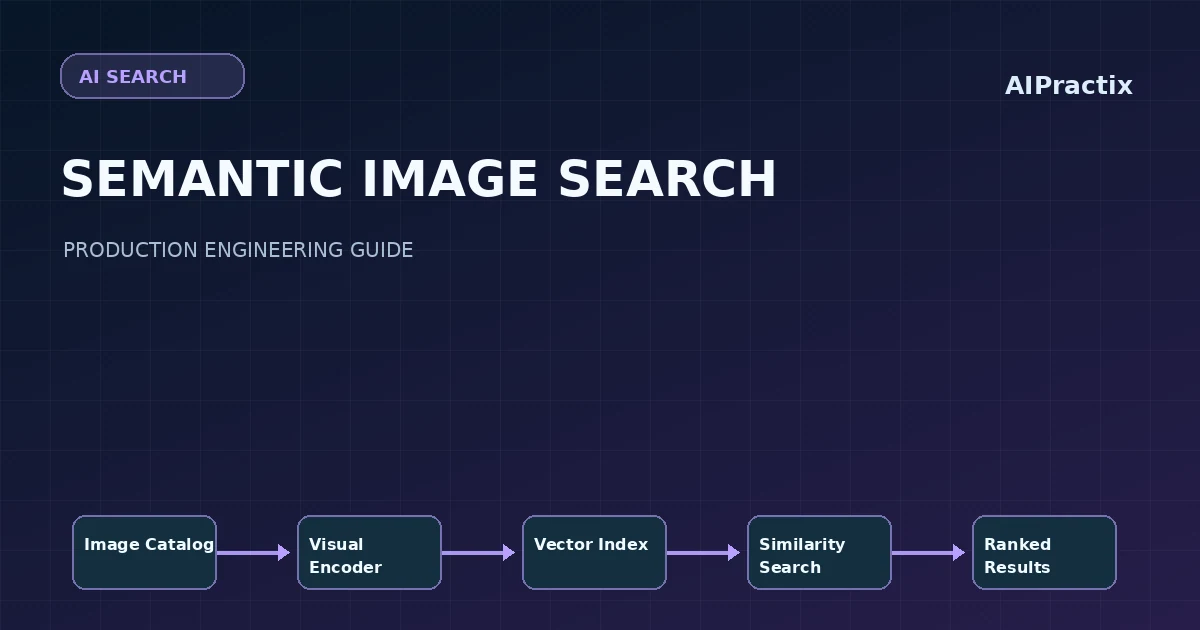
Traditional image search often depends on manually written keywords, categories, and filenames. Semantic image search uses learned representations to retrieve visually or conceptually related content even when the query and stored item do not share explicit text labels.
A prototype may consist of an embedding model and a nearest-neighbor library. A production system additionally needs ingestion, metadata consistency, index updates, filters, quality evaluation, and customer-facing APIs.
AIPractix has explored retrieval-oriented applications through FeatSearch. This article outlines general system design principles rather than claiming specific undocumented FeatSearch features.
2. Choose the Retrieval Objective
Image-to-image search finds visually similar items from an example image. Text-to-image search finds images that correspond to a language query when the embedding approach supports cross-modal alignment.
These objectives can require different models and evaluation datasets. A visual similarity model may consider two products similar because of color or silhouette, while a text-aligned model may prioritize semantic category. Decide what relevance means to the customer before tuning the system.
3. Build the Ingestion Pipeline
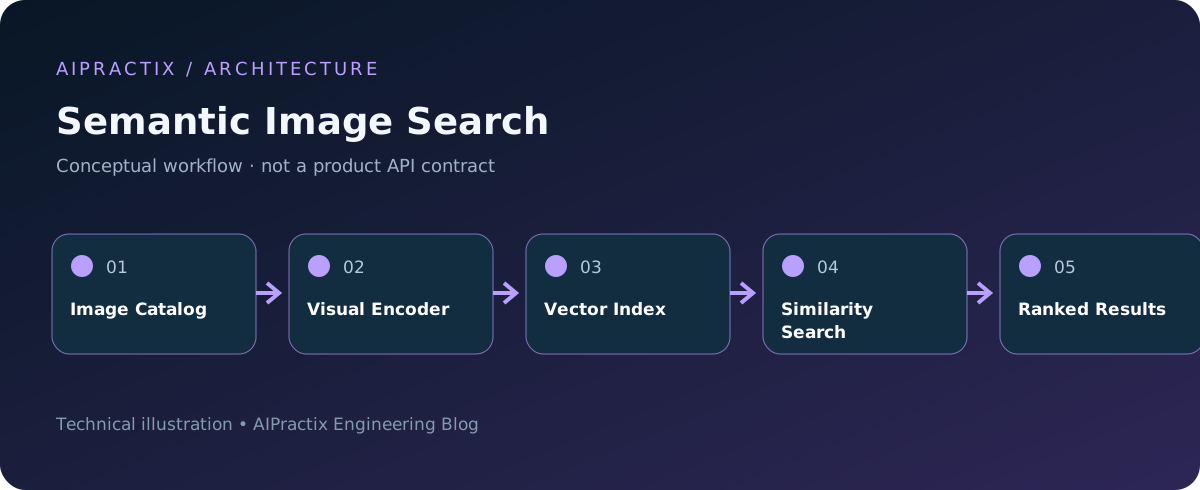
Image ingestion should validate formats, decode safely, apply deterministic preprocessing, and handle duplicate or near-duplicate assets. Keep a durable mapping between asset IDs, vector IDs, and metadata records.
If the embedding model changes, rebuild or migrate the index under a versioned plan. Storing only vectors without a reproducible source mapping makes future maintenance difficult.
4. Understand Embeddings and Similarity
An image embedding is a vector designed to preserve particular relationships learned during model training. Cosine similarity or normalized dot product is commonly used for ranking, depending on the model.
A similarity score is not inherently a probability of purchase intent, visual identity, or user satisfaction. Evaluate it against annotated relevance judgments and the intended retrieval task.
Model choice should reflect expected objects, image quality, languages for text queries, domain-specific terminology, and compute constraints.
5. Design the Vector Search Layer
Exact nearest-neighbor search can be effective for moderate collections. At larger scales, approximate nearest-neighbor methods trade some recall for speed and resource efficiency.
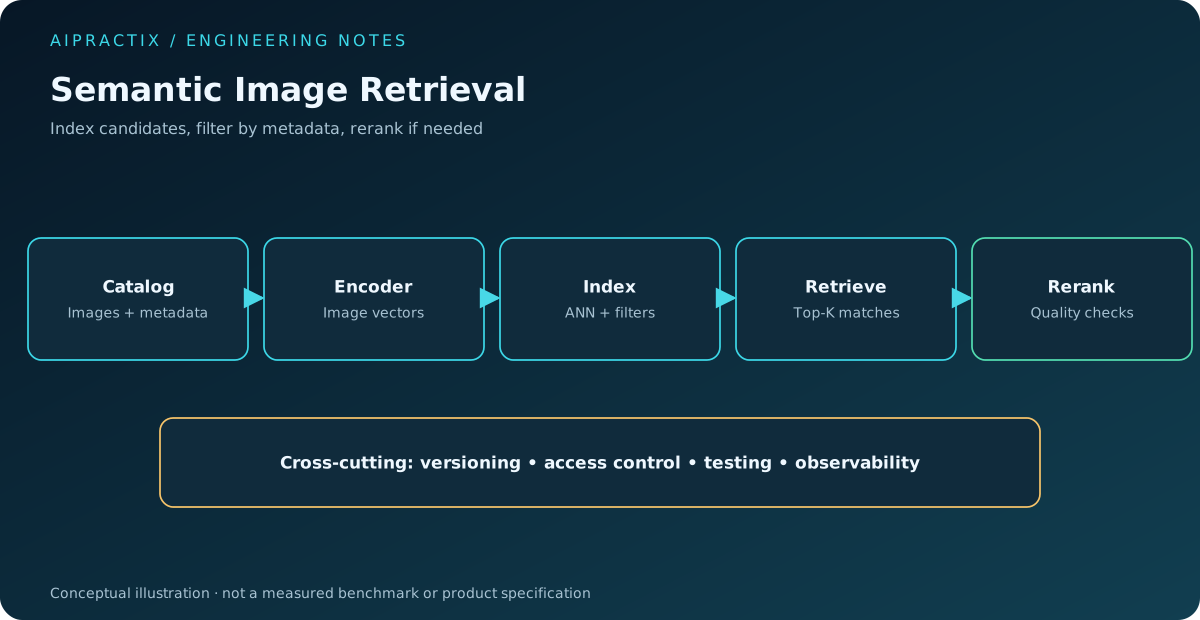
Benchmark recall@K, query latency, index size, ingestion speed, deletion behavior, and concurrent workload. Search quality also depends on how metadata filters interact with vector retrieval. A filter applied after retrieving only a tiny candidate set can discard all useful results.
6. Combine Semantic Search With Metadata
Retail and enterprise search rarely depend on visual similarity alone. Users may filter by brand, category, availability, permissions, site, or date. Design filters that are correct and authorized, not merely convenient.
A practical ranking strategy can combine embedding similarity with structured constraints and business-specific signals. Keep sponsored or commercial ranking signals transparent where relevant, and avoid claiming that a learned score is objectively the best match for every user.
7. Improve Results With Reranking
An inexpensive first-stage index can retrieve a larger candidate pool. A more precise model or domain-specific scoring function can rerank the candidates before display.
This two-stage design often improves relevance without applying the most expensive computation to every catalog item. Benchmark added latency and use realistic query traffic; better offline ranking metrics do not automatically justify slower user interactions.
8. Evaluate Search Like a Product
Useful metrics include recall@K, precision@K, nDCG, search latency, zero-result rate, and real-world engagement measures interpreted carefully. Build relevance sets covering common, uncommon, ambiguous, and visually difficult queries.
For product imagery, include varied angles, backgrounds, lighting, and catalog photography styles. For enterprise media libraries, test permission filtering and deletion propagation as well as ranking quality.
9. Operational Concerns
Support incremental indexing, retries, failure queues, vector/model versioning, audit logs, access control, and observability. Keep source images and search metadata under appropriate retention and authorization rules.
Search results should degrade predictably when an index is rebuilding or an embedding service is unavailable. A searchable product is an operating service, not just an offline embedding notebook.
10. Conclusion
Semantic image search becomes valuable when relevant retrieval is delivered consistently through stable APIs, up-to-date indexes, and defensible ranking. Good embeddings matter, but ingestion, metadata, evaluation, and operations turn the technology into a product.